Prompt
Description
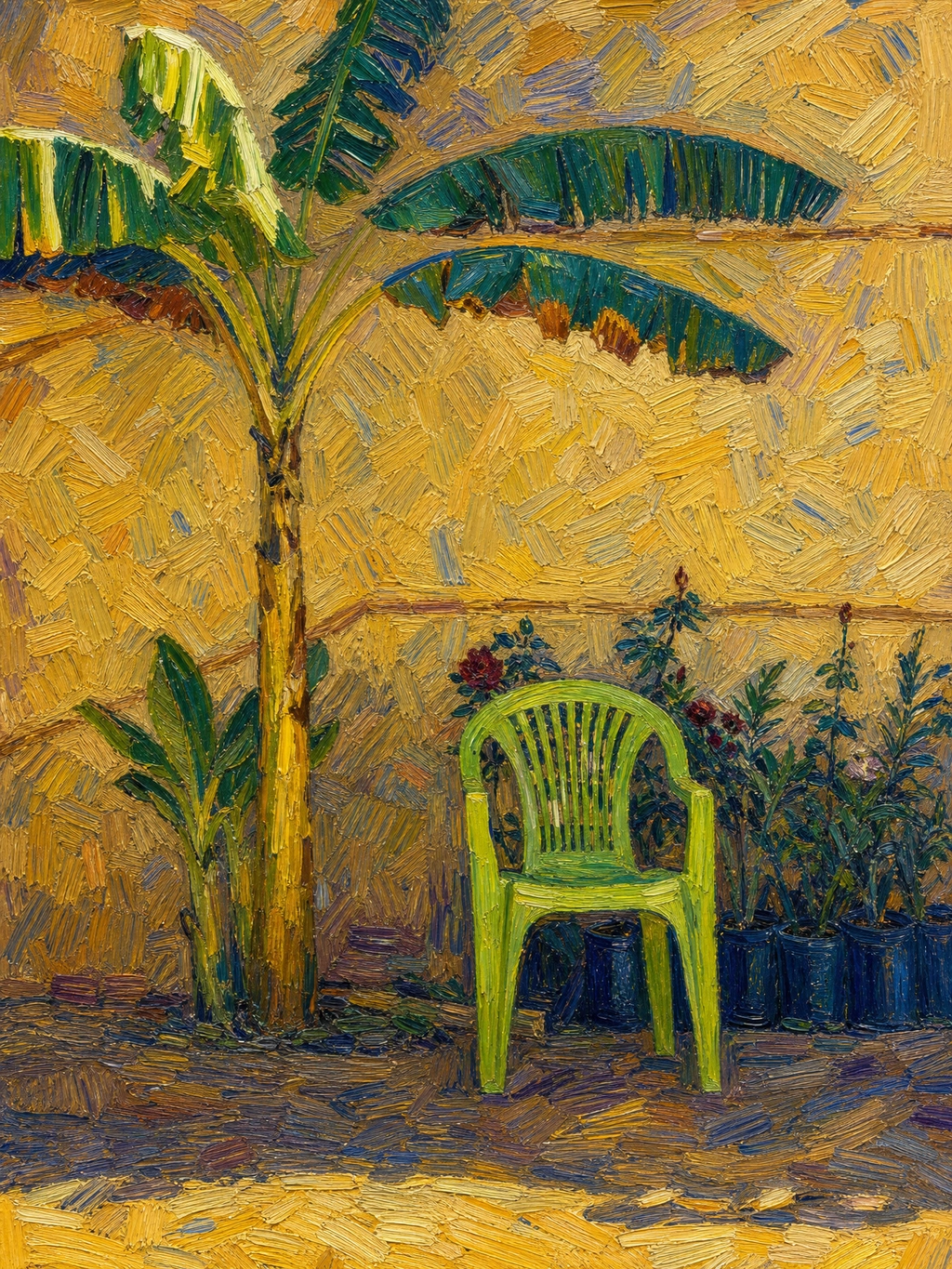
Use the uploaded image as the absolute structural and semantic reference. Transform the image into an expressive late-19th-century Post-Impressionist oil painting inspired by Vincent van Gogh's characteristic pictorial language, while preserving the original image's subject matter, identity, composition, pose, proportions, perspective, spatial relationships, objects, architecture, landscape features, framing, and overall scene organization. Do not redesign, replace, add, or remove elements merely to make the scene look more like a famous painting. The source image determines WHAT is depicted; the painting references determine HOW it is painted. Reinterpret all visible surfaces through energetic, clearly articulated oil brushwork. Replace photographic smoothness with tangible painted texture and directional strokes that follow the underlying forms: curved and contour-following strokes across faces and bodies, rhythmic strokes across clothing and objects, structured linear marks across architecture, and more fluid, organic strokes across vegetation, clouds, water, ground, and other natural elements whenever those elements actually exist in the source image. Create the impression of thick, tactile oil paint applied to a textured canvas. Use visible impasto-like ridges, layered pigment, broken-color passages, short repeated strokes, expressive contour marks, and subtle variations in stroke direction, thickness, density, and length. Every brushstroke should contribute to volume, movement, depth, or emotional intensity rather than appearing as a generic digital painting filter. Translate the original colors into a vivid Post-Impressionist palette while respecting their underlying relationships. Intensify color through complementary contrasts and neighboring strokes of distinct pigments rather than smooth digital gradients. Use rich ultramarine, cobalt and blue-green notes where appropriate; ochre, golden yellow, amber and warm orange where supported by the source; earthy greens, muted olive tones, burnt sienna, reddish browns, vermilion and restrained dark accents according to the actual colors and lighting of the original scene. Do not force these colors onto objects that would contradict the source image. Model light and shadow primarily through color relationships and directional brushwork rather than photorealistic shading. Preserve the original direction and logic of the illumination, but reinterpret highlights and shadows as layered painted passages. Maintain believable depth while allowing slight expressive exaggeration of chromatic contrast. Use strong but organic outlines selectively around important forms. Allow contours to vary in thickness, color, and intensity. Avoid perfectly clean vector-like edges. Shapes should remain recognizable and structurally faithful while possessing the slight irregularity of hand-painted oil work. For portraits or people, preserve facial identity, recognizable anatomy, expression, gaze direction, hairstyle, clothing, pose, hands, body proportions, and placement exactly as established by the reference. Translate skin into layered ochres, warm earth colors, muted reds, cool complementary shadows, and individually visible strokes that describe facial planes and anatomy. Do not distort facial features merely for stylistic effect. For landscapes, preserve the exact geography and arrangement of the source while allowing vegetation, fields, clouds, water, and terrain to acquire rhythmic directional brushwork. Introduce swirling or wave-like movement only where naturally compatible with the forms already present; do not automatically turn every sky into a “Starry Night” sky. For architecture and interiors, preserve structural geometry and object placement while rendering surfaces with hand-painted irregularity, visible pigment variation, expressive perspective accents, and directional strokes appropriate to walls, floors, furniture, windows, streets, and other existing structures. For night scenes, preserve the actual nighttime composition while emphasizing luminous color relationships, deep blues, contrasting warm artificial lights, visible brushwork, and painterly halos only around light sources that actually exist. For still lifes, preserve the number, shape, position, scale, and type of objects while emphasizing tactile paint, chromatic contrast, expressive contours, and brushwork that follows each object's volume and material. Maintain the original crop and aspect ratio. Preserve foreground, middle ground, background, negative space, focal hierarchy, camera viewpoint, and relative scale of every important element. The finished result must unmistakably read as a genuine physical oil painting rather than a photograph with a digital art filter: richly textured canvas, layered pigments, visible brush marks, occasional impasto, expressive chromatic modeling, handcrafted irregularities, rhythmic directional strokes, strong visual energy, and cohesive Post-Impressionist painterly treatment across the entire image. Preserve exactly: the original subject and identity; facial characteristics when people are present; expression; pose; anatomy; hands; clothing design; objects; object count; environment; architecture; landscape layout; composition; crop; perspective; relative proportions; spatial relationships; lighting direction; major color relationships; foreground, middle ground and background organization. Modify only: the visual medium, surface treatment, brushwork, paint texture, pigment behavior, chromatic interpretation, edge treatment, painterly modeling, and overall rendering language. Avoid: adding famous Van Gogh motifs that are absent from the source, arbitrary stars, unnecessary sunflowers, invented cypress trees, additional people or objects, altered facial identity, changed pose, anatomical deformation, missing fingers, extra fingers, distorted architecture, changed perspective, displaced objects, excessive abstraction, smooth digital gradients, airbrushed surfaces, plastic textures, watercolor appearance, acrylic appearance, flat cartoon rendering, generic Photoshop filters, uniform brush patterns, repetitive procedural texture, text, signatures, frames, borders, or watermarks. Final objective: the viewer should immediately recognize the original image and its exact visual content, but perceive it as if the entire scene had been physically reconstructed with expressive late-19th-century Post-Impressionist oil-painting techniques associated with Vincent van Gogh—without copying the composition of any specific existing Van Gogh painting.
The Prompt
Use the uploaded image as the absolute structural and semantic reference. Transform the image into an expressive late-19th-century Post-Impressionist oil painting inspired by Vincent van Gogh's characteristic pictorial language, while preserving the original image's subject matter, identity, composition, pose, proportions, perspective, spatial relationships, objects, architecture, landscape features, framing, and overall scene organization. Do not redesign, replace, add, or remove elements merely to make the scene look more like a famous painting. The source image determines WHAT is depicted; the painting references determine HOW it is painted. Reinterpret all visible surfaces through energetic, clearly articulated oil brushwork. Replace photographic smoothness with tangible painted texture and directional strokes that follow the underlying forms: curved and contour-following strokes across faces and bodies, rhythmic strokes across clothing and objects, structured linear marks across architecture, and more fluid, organic strokes across vegetation, clouds, water, ground, and other natural elements whenever those elements actually exist in the source image. Create the impression of thick, tactile oil paint applied to a textured canvas. Use visible impasto-like ridges, layered pigment, broken-color passages, short repeated strokes, expressive contour marks, and subtle variations in stroke direction, thickness, density, and length. Every brushstroke should contribute to volume, movement, depth, or emotional intensity rather than appearing as a generic digital painting filter. Translate the original colors into a vivid Post-Impressionist palette while respecting their underlying relationships. Intensify color through complementary contrasts and neighboring strokes of distinct pigments rather than smooth digital gradients. Use rich ultramarine, cobalt and blue-green notes where appropriate; ochre, golden yellow, amber and warm orange where supported by the source; earthy greens, muted olive tones, burnt sienna, reddish browns, vermilion and restrained dark accents according to the actual colors and lighting of the original scene. Do not force these colors onto objects that would contradict the source image. Model light and shadow primarily through color relationships and directional brushwork rather than photorealistic shading. Preserve the original direction and logic of the illumination, but reinterpret highlights and shadows as layered painted passages. Maintain believable depth while allowing slight expressive exaggeration of chromatic contrast. Use strong but organic outlines selectively around important forms. Allow contours to vary in thickness, color, and intensity. Avoid perfectly clean vector-like edges. Shapes should remain recognizable and structurally faithful while possessing the slight irregularity of hand-painted oil work. For portraits or people, preserve facial identity, recognizable anatomy, expression, gaze direction, hairstyle, clothing, pose, hands, body proportions, and placement exactly as established by the reference. Translate skin into layered ochres, warm earth colors, muted reds, cool complementary shadows, and individually visible strokes that describe facial planes and anatomy. Do not distort facial features merely for stylistic effect. For landscapes, preserve the exact geography and arrangement of the source while allowing vegetation, fields, clouds, water, and terrain to acquire rhythmic directional brushwork. Introduce swirling or wave-like movement only where naturally compatible with the forms already present; do not automatically turn every sky into a “Starry Night” sky. For architecture and interiors, preserve structural geometry and object placement while rendering surfaces with hand-painted irregularity, visible pigment variation, expressive perspective accents, and directional strokes appropriate to walls, floors, furniture, windows, streets, and other existing structures. For night scenes, preserve the actual nighttime composition while emphasizing luminous color relationships, deep blues, contrasting warm artificial lights, visible brushwork, and painterly halos only around light sources that actually exist. For still lifes, preserve the number, shape, position, scale, and type of objects while emphasizing tactile paint, chromatic contrast, expressive contours, and brushwork that follows each object's volume and material. Maintain the original crop and aspect ratio. Preserve foreground, middle ground, background, negative space, focal hierarchy, camera viewpoint, and relative scale of every important element. The finished result must unmistakably read as a genuine physical oil painting rather than a photograph with a digital art filter: richly textured canvas, layered pigments, visible brush marks, occasional impasto, expressive chromatic modeling, handcrafted irregularities, rhythmic directional strokes, strong visual energy, and cohesive Post-Impressionist painterly treatment across the entire image. Preserve exactly: the original subject and identity; facial characteristics when people are present; expression; pose; anatomy; hands; clothing design; objects; object count; environment; architecture; landscape layout; composition; crop; perspective; relative proportions; spatial relationships; lighting direction; major color relationships; foreground, middle ground and background organization. Modify only: the visual medium, surface treatment, brushwork, paint texture, pigment behavior, chromatic interpretation, edge treatment, painterly modeling, and overall rendering language. Avoid: adding famous Van Gogh motifs that are absent from the source, arbitrary stars, unnecessary sunflowers, invented cypress trees, additional people or objects, altered facial identity, changed pose, anatomical deformation, missing fingers, extra fingers, distorted architecture, changed perspective, displaced objects, excessive abstraction, smooth digital gradients, airbrushed surfaces, plastic textures, watercolor appearance, acrylic appearance, flat cartoon rendering, generic Photoshop filters, uniform brush patterns, repetitive procedural texture, text, signatures, frames, borders, or watermarks. Final objective: the viewer should immediately recognize the original image and its exact visual content, but perceive it as if the entire scene had been physically reconstructed with expressive late-19th-century Post-Impressionist oil-painting techniques associated with Vincent van Gogh—without copying the composition of any specific existing Van Gogh painting.